 The last time I was in my hometown of Vancouver, I saw my cousin Marion, who gave me a bottle of red wine from one of her favored British Columbian producers. I saved it to open tonight since rack of lamb is in the oven. The wine is 2008 Laughing Stock Vineyards, Portfolio from the Okanagan. More specifically, the winery is in Penticton, a gorgeous town in the Okanagan valley. I have fond memories of Penticton, though I was there prior to the fairly recent boom in the wine industry. The winery is owned by Edmonton-born David Enns who made his first wine here in 2001. Before being a winemaker, he was in the financial industry in Vancouver, which may account for why his whimsical labels look like ticker tapes and the winery and wine names make reference to the stock market. They have 2.2 hectares (5.4 acres) of vines on Naramata Road in Penticton, a very small production family owned winery. 2008 Portfolio is a Bordeaux-style blend made from 53% Merlot, 24% Cabernet Sauvignon, 12% Cabernet Franc, 12% Malbec, and 2% Petit Verdot. It spends 19 months in barrel 50% new and 50 second use, 100% French oak. I have to say that I very much like the wine! It has a pretty nose of blackberries, blueberries, and creamy vanilla, not oak, and on the palate, the wine is juicy, round, pleasant, with nice weight, without being too jammy or oaky. The wine is going perfectly with my lamb right now, and I'm finding myself curious about making a journey to go visit the winery. Thank you Marion for a great bottle of wine and look forward to seeing you soon!
Monday, April 4, 2011
Canadian red wine with rack of lamb - not bad for a Monday
The last time I was in my hometown of Vancouver, I saw my cousin Marion, who gave me a bottle of red wine from one of her favored British Columbian producers. I saved it to open tonight since rack of lamb is in the oven. The wine is 2008 Laughing Stock Vineyards, Portfolio from the Okanagan. More specifically, the winery is in Penticton, a gorgeous town in the Okanagan valley. I have fond memories of Penticton, though I was there prior to the fairly recent boom in the wine industry. The winery is owned by Edmonton-born David Enns who made his first wine here in 2001. Before being a winemaker, he was in the financial industry in Vancouver, which may account for why his whimsical labels look like ticker tapes and the winery and wine names make reference to the stock market. They have 2.2 hectares (5.4 acres) of vines on Naramata Road in Penticton, a very small production family owned winery. 2008 Portfolio is a Bordeaux-style blend made from 53% Merlot, 24% Cabernet Sauvignon, 12% Cabernet Franc, 12% Malbec, and 2% Petit Verdot. It spends 19 months in barrel 50% new and 50 second use, 100% French oak. I have to say that I very much like the wine! It has a pretty nose of blackberries, blueberries, and creamy vanilla, not oak, and on the palate, the wine is juicy, round, pleasant, with nice weight, without being too jammy or oaky. The wine is going perfectly with my lamb right now, and I'm finding myself curious about making a journey to go visit the winery. Thank you Marion for a great bottle of wine and look forward to seeing you soon!

Saturday, April 2, 2011
Pouring Salwey reds and Hooked Riesling @ El Vino Wine Shop for Venice Beach's "First Friday"

The first Friday of every month brings a festive block party to Abbott Kinney Boulevard in Venice Beach, California, a party featuring art galleries displaying their lastest holdings, bars and restaurants opening late, and a wine shop called El Vino that hosts a special wine tasting. This month, on April 1, I was invited by El Vino owner Bart Miali to pour three wines from the Rudi Wiest portfolio for First Friday, when he expected to have between 100 to 150 people come and taste wine! The small, modern, ecclectic shop was buzzing all evening with happy revelers looking to kick off the first warm weekend in spring. People from all over, but mostly locals from around Venice, Marina del Rey, Playa Vista, and Palms came by and bellied up to the bar to taste three wines for $10.
The first of the wines we served was the 2008 Salwey Estate Pinot Noir from the Kaiserstuhl, Baden, which is a terrific little Pinot Noir with forest floor and bright cherry and spice notes. While definitely light bodied, like most German Pinot Noirs when compared with California Pinot Noirs to which most palates here are accustomed, the wine is rich in flavor, and I would say that more people last evening who tasted the wine got it than didn't. Those that liked it praised the wine for its complexity, acidity and overall delicious bright flavor; those who didn't like it felt the cherry flavors in it were unripe (I would describe it more as bright and maybe sour cherry than unripe). This wine is terrific with roast duck breast, duck confit, roast chicken, and cured meats. The second of the wines was also from Salwey - 2008 Salwey "16 Degrees" Red Wine - a blend of Pinot Noir and St. Laurent, named 16 Degrees as the winemaker felt this wine should be served at 16 degrees Celsius - a clever point that most tasters accept but have a tougher time knowing what it really means - it actually translates to about 61 degrees Farenheit... basically it means just a tad below room temp, and as the temperature in the tasting room and shop as a whole went up due to there being so many people in it, we began putting bottles of this wine into the ice bucket, which nicely chilled it down. The 16 Degrees has a richer color in the glass than does the Pinot Noir, the St. Laurent grape giving the wine more juicy, ripe fruit character, a rounder palate, but also a bit less complexity - a bit more of a fun red wine blend, with a little more stuffing so it can go well with a burger or a steak, even. Finally, the third wine in the flight was the 2008 Hooked! Riesling from the Nahe region, a Rudi Wiest negotiant wine, where Rudi sourced the grapes and found a winemaker to produce the wine, and he also used an artist he likes out of Berlin to create the label. The Hooked Riesling showed beautifully - it's medium-dry palate was a perfect crispness and fruitiness - like biting into fresh green grapes and apples - that appealed widely to the crowd last evening. It's the perfect Riesling to serve to a varied crowd on a Friday evening, and the price was even better - only $10.99. By the end of the evening, around 10:30 pm, we had indeed served about 100 or more tasters, gone through at least a case of each wine, and sold even more. A good time was had by all, and the wine merchant of Venice, El Vino, enjoyed a successful night.
Monday, March 28, 2011
Showing the wines of Schloss Schonborn
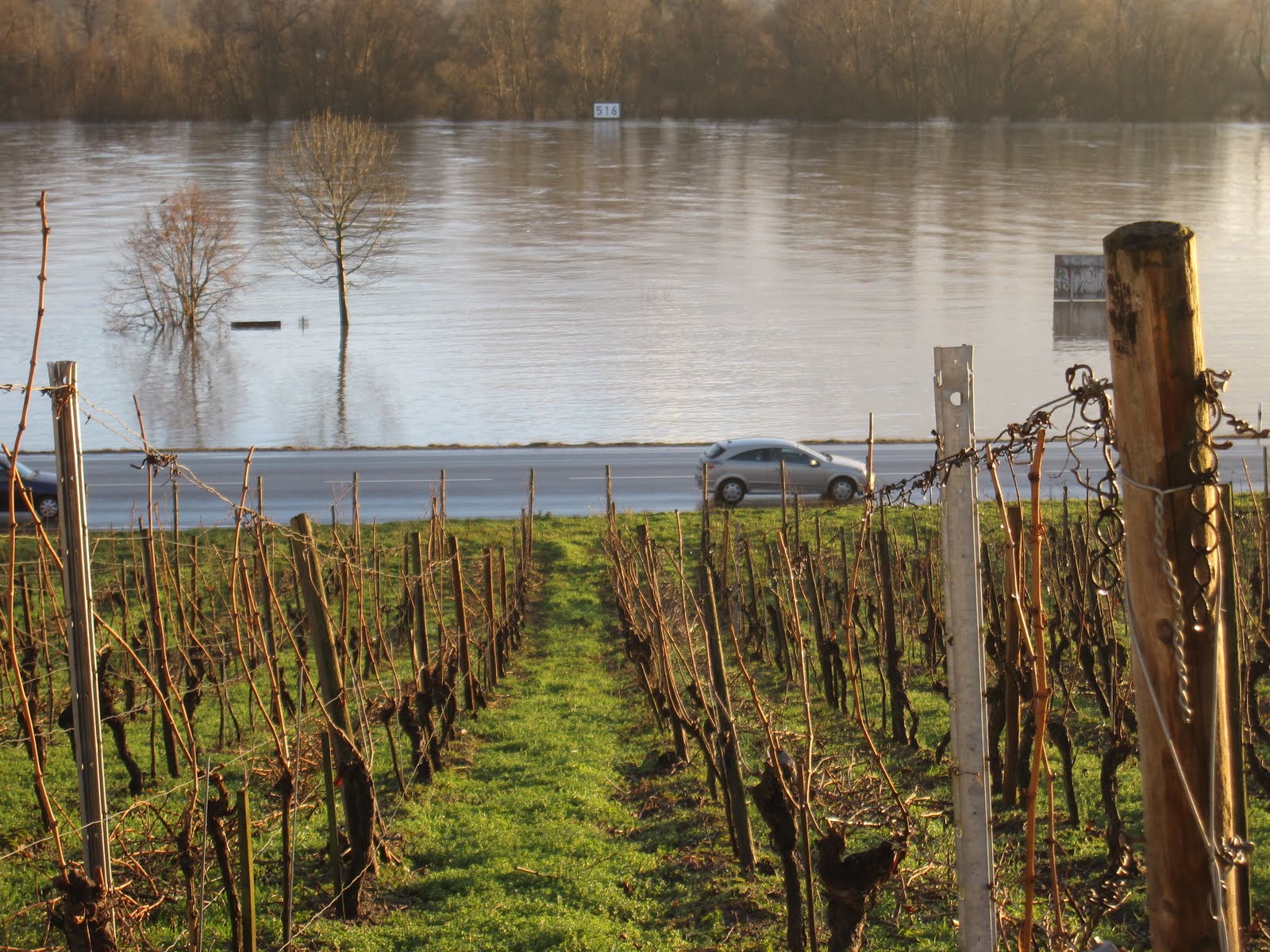 The first time I tasted the wines of the Schloss Schonborn estate, it was on January 18 of this year - I had literally just gotten off the plane that Tuesday morning in Frankfurt, was driven to the Franz Kunstler estate in the Rheingau, where we walked the vineyard for a bit then had some delicious homemade chili for lunch, then had my first taste of the very exciting 2010 vintage Rieslings, along with Gunter Kunstler's vivid descriptions of how the volcanic eruptions of the spring of 2010 may have caused weather disruptions that disturbed the normal flowering of the grapevines. Right after that, we were whisked to the Schloss Schonborn Estate, a new Rheingau estate in our portfolio. My mind was muddled, but I remember whipping out my camera when our car pulled up as the winter sun was shining on the river and the grass between the naked vines were a vibrant light green, glistening from a recent rain. We were high up on a hillside and the vines went all the way down to the street below, where cars wizzed by, threatening to decimate anyone who might lose their step on the precariously steep vineyard. Established in 1349, this estate was making wine before glass bottles were popularized, before the Americas were discovered, before a lot of things, in other words. Their first wines were stored and served from wood barrels, until 1725 when they bottled their own wines. The estate has been owned by a line of counts, known as the the Grafs of Schonborn. The current Graf owns the estate here in the Rheingau, as well as an estate in the Franken region known as Schloss Hallburg. I would have no recollection on how I found the wines that day back in January when I had just gone 24 hours without sleep, having finished an entire novel on my new Kindle on my flight over to Germany, but fortunately, I took notes on the wines I tasted that day and put stars next to the wines I particularly found delicious. Fast forward three months to last week, when I had the opportunity to work with Schloss Schonborn's winery rep Marc Ramershoven, who flew in to the west coast to work with us in California before he was headed up to Vancouver, B.C. to pour at the International Wine Festival that takes place there every spring (I have never been). Marc brought with him 8 samples of wine from both the Rheingau and Franken estates of Schonborn, and I had a chance not only to revisit these wines again, but to show them to a select group of my customers.
  I have to say that of the wines he showed, the most impressive for me were his three dry Rieslings from the Rheingau. He showed a 2010 Schloss Schonborn Estate Riesling trocken, 2009 Schloss Schonborn Winkeler Hasensprung Riesling Spatlese trocken, and 2009 Schloss Schonborn Erbacher Marcobrunn Erstes Gewachs Riesling trocken. All three of them were so uniquely different. The 2010 Estate trocken was so crisp and refreshing and light and fresh on the palate. Great nose, perfect for that plate of oysters or just sipping by itself to get your appetite going. What a great little dry Riesling, terrific fruit, while staying dry, but not austere or excessively lean. Love this wine, will sell lots of it, I am certain. The second one, the 2009 Hasensprung Riesling Spatlese trocken - superb - infinitely different from the 2010 Estate dry - this Spatlese trocken is noble, rich, lengthy on the palate, with stone fruits, delicate mineral, a serious dry Riesling with terrific fruit yet again, but richer without being overly alcoholic. Finally, the 2009 Erstes Gewachs from the famous Marcobrunn vineyard - this is a terrific and delicious wine and shows the beauty of the first growth Rheingau wines. Peaches, limestone, powerful yet crystalline in its purity, mouthfilling, yet not overpoweringly so. This is a wine that can hold up to meat dishes or just drink it by itself and enjoy. Interestingly enough, I looked back in my notebook to that day back in January at the estate and it looks like among the 24 wines we tasted there, I put stars next to 09 Hasensprung Spatlese trocken and 09 Marcobrunn EG. I guess I liked them then and there and I like them here and now. The rest of the collection we showed were also terrific and top-notch - an interesting Pinot Gris "3 Star" from Franken which is a Pinot Gris harvested at Spatlese to Auslese level and fermented dry and put into a Burgundy bottle to likely communicate that this is a wine more like a white Burgundy in style than any Pinot Gris we tend to think of. This is not a crisp light white, more of a rich, full-bodied white, minus the oakiness one might find with Chardonnay. There were two Roses we showed, one from the Rheingau estate made exclusively of Pinot Noir, called 2010 Schloss Schonborn "PINK", and one from the Franken estate made from a blend of red local varieties, mostly hybrids of Dornfelder... there was also a Silvaner from Franken and a 2003 Schloss Schonborn Pfaffenberg Riesling Kabinett in a fruity style from a single vineyard, a monopole vineyard called Pfaffenberg, in the Rheingau. The 03 showed pretty well, not showing its 8 years at all, and maintaining a very decent acid profile, good balance overall. A wine that would be a terrific fruity Riesling by the glass. In all, I'm very happy we have this new to us estate Schloss Schonborn to work with. Everywhere we went during this work-with, wine folks seemed to have a very good impression of the estate, and loved the quality of the wines. I'm looking forward to having these wines in stock; they arrive to our warehouses in May.
Friday, March 4, 2011
Mystery of the Rebholz Pinot Noir solved
 When I was in Germany earlier this year with my coworkers and management of Rudi Wiest Selections, tasting the new releases from the estates we represent, we were all floored and surprised at how delicious the 2008 Rebholz Pinot Noir (Spatburgunder) Tradition was. In fact, I think I even heard Rudi Wiest himself say that this was the best vintage of Rebholz Pinot Noir Tradition he had ever tasted. The Rebholz Pinot Noir Tradition is their entry level Pinot Noir - "Tradition" simply means their "basic" wine here - this is not single vineyard, it is essentially their "Estate" offering. But this very basic Pinot Noir is not so basic in its price point; it wholesales for over $30 a bottle and retails for about $45 and is on wine lists for about $70-$80, so because of this, it doesn't get as much play as less expensive Pinot Noirs in our portfolio.
Well, the 2008 vintage of this Pinot Noir was so good, that I decided right then and there in Hansjorg Rebholz's tasting room that when I returned to the U.S., I would pull some samples of the 2007 we had in stock (2008 would be coming in several months) and show off the beautiful wine.
Finally, two days ago, I opened a bottle and poured it for several of my restaurant and retail accounts. The reaction was interesting - not what I expected. The wine was rich in color and body, which normally appeals well to many a North American palate - but my audience felt the wine showed too much oak on the nose and on the palate. As though the wine was disjointed both in its aroma and in its flavor profile, with too much new oak and cedar showing through. It was surprising to everyone - people have come to expect German Pinot Noirs to be elegant and ethereal and light on their feet, never showing excessive oak like their New World counterparts.... but here they found it in the 2007 Rebholz Pinot Noir (Spatburgunder) Tradition. I was also confused by this.
Day 2, I continued to show the wine, after letting the bottle rest in my fridge overnight. Again, I got the same reaction with the wine. After a second day of lack of success in converting any of my accounts to this wine, I gave up. I left what was left of the wine on my counter.
Day 3 - It's Friday night. My husband inquires about half bottle of red wine sitting on the counter. I answered "I don't think it will be any good. It's day 3. It's a Pinot Noir. It's probably no good anymore. Plus, I didn't get very good reactions to the wine when I showed it." I was not really enthusiastic about the wine, as you can tell about my comments.
We tasted it anyway. And lo and behold, it was fantastic! Even before I tasted it, actually. I stuck my nose into the glass and the aroma already told the whole story. There wasn't that aggressive oak that everyone was complaining about when I opened it for my customers. Instead, there was a beautiful bouquet of red roses intermingling with black cherries and vanilla bean. Absolutely nothing that reminded me of oak. Nothing! On the palate, the wine is bold while being silky, with some grippy tannins, but very balanced acidity and fruit and structure. Completely perfect in its richness - a terrific Pinot Noir for those who don't like their Pinots too delicate, because this one is not.
While I thought this wine on day 3 would be oxidized and unpleasant, it was perfect, absolutely perfect, and this is what I should have been showing my customers all along, this specimen of beauty and strength instead of that tight, angular, unbalanced wine that obviously did not get enough air and breathing room in the last 2 days.
I am still at this time enjoying a sip of the beautiful 2007 Rebholz Pinot Noir Tradition, wishing that this is how it showed when I was dragging it from place to place. If only I had known to open it two days earlier, sat it on the counter, letting it breath a bit around a loosely replaced cork.... if only I knew, it would be on a few more wine lists and in a few more wine shops.
Alas I have another sample and I can do just that with it.
Wednesday, March 2, 2011
A terrific day tasting the wines of Von Buhl Estate with Christoph Graf
 Christoph Graf of Von Buhl Estate in the Pfalz, Germany, was down this week in the Los Angeles area showing a terrific line-up of Von Buhl wines. We ended up driving almost 200 miles that day, tasting with wine directors, sommeliers, buyers and restaurant and retail store owners in such diverse establishments as Inn of the Seventh Ray (pictured above) in Topanga Canyon, Spago and Cut and Whole Foods in Beverly Hills, Pourtal Wine Bar in Santa Monica, the Wine House in West Los Angeles, and the Starling Diner and The Wine Country in Long Beach. Yes, we were all over the map, but it was worth it because so many people got to taste Christoph's lovely wines.
We had 10 wines in our wine carrier. Christoph started the tasting with two sparkling wines, called Sekt in German - there was the 2008 Riesling Sekt, made from 100% Riesling grapes harvested in the Pfalz region, and made in the Champagne method - methode traditionelle - that means bottle fermentation, riddling, disgourging the yeast, the whole bit! This is a very complex and delicious sparkling Riesling with tons of flavor for an easy to swallow price. Very impressive.
Next came the 2008 Spatburgunder Rose Sekt - a sparkling wine made again in the Champagne method, but this time with 100% Pinot Noir. This is a very pale colored rose - so pale that many in the American market would not recognize it as a rose. It was more of a pale Champagne color one might say. Some suggested that perhaps this could be called a Blanc de Noirs, but actually von Buhl has a Blanc de Noirs that is much paler than this. The explanation for the pale color is actually that Germans don't really like that really pink color in their Rose sparklings because it means that a lot of red wine was added to make that color - ie. it is kind of articially created instead of more naturally focused to taste. Anyway, the wine is of course delicious, deep in flavor, rich and serious.
After that, we tasted the 2010 Pinot Noir Rose - this is a still Rose that is definitely a pretty pink in color and juicy and very elegant - a beautiful little summer Rose - I sold tons of this one with Christoph! 100% Pinot Noir - and it shows its purity.
Next up was something different - 2010 Sauvignon Blanc. This wine stole the show. First because many people we visited had never tasted German Sauvignon Blanc, and didn't even know that Germany produced Sauvignon Blanc. But Christoph quickly informed us that actually there are 600 hectares of Sauvignon Blanc being grown in Germany, and the German market loves the wine, so it has been doing very well in the restaurant scene. The 2010 Von Buhl Sauvignon Blanc combines the best of the new world and old world styles by having a lively New Zealand nose, followed by a very European palate - more stone, minerality, and clean zesty fruit like one would find in Sancerre. A very pretty wine and modest price tag which makes this wine a shoo-in for restaurant by-the-glass programs.
There were 6 more wines after these ones. I'll review that in the next post.

Thursday, February 3, 2011
A successful 2010 preview tasting
 Just returned from a very successful preview showing the of the barrel samples we hauled back from Germany last week. We brought 24 wines from 22 different estates, everything from dry Gewurztraminer, Pinot Blanc, Pinot Gris, Scheurebe, and Pinot Noir, to Rieslings from dry to Kabinett to Spatlese. Needless to say, the wines were stunning and our guests, restauranteurs and quality wine merchants, sommeliers and Master Sommeliers alike were all very impressed with the 2010 white wines and roses and the 2009 and 2008 Pinot Noirs.
Rudi Wiest presided over the tasting, having just flown in that morning from New York City, where he had done this same preview tasting on Monday. He had been up since 3 am EST, or 12 midnight PST, and yet he was full of energy, as usual, discussing the wines he loves.
A special thank you to our host Randi at our venue, Bottle Rock in Culver City. Beautiful glassware that did our wines justice, a terrific lunch that hit the spot, and everything about the tasting was well timed, which is just so very important.
Not sure which wines people loved the most, but from what I heard, these were some wines that got oohs and ahhhs:
2010 Dr. F. Weins-Prum Wehlener Sonnenuhr Riesling Spatlese
2008 Rebholz Pinot Noir tradition
2009 Furst Pinot Noir tradition
2010 Von Buhl Pinot Noir Rose
2010 Pfeffingen Scheurebe trocken (dry)
2010 Pfeffingen Gewurztraminer trocken (dry)
2010 Zilliken Saarburger Rausch Riesling Kabinett
Sunday, January 30, 2011
2010 German wine vintage report - a review from 11 days in Germany
 Hello everyone, freshly back from Germany following an approximately 2-week long trip through the wine regions of Franken, Wurttemburg, Baden, Pfalz, Rheingau, Rheinhessen, Mosel, and Ahr. Here are my impressions of the 2010 vintage.
My reaction was that the wines were surprisingly good. There were murmurs prior to going on this trip that the 2010 vintage was a difficult one, compared to the perfect 2009 vintage, given how cold the weather was in 2010. My taste buds braced for an assault. Instead, they were treated to a happy surprise.
So how come the wines were so shockingly good in a vintage some described as cold and difficult?
The truth was that the vintage was different. Completely different from the one before it, 2009, and different from many other vintages too. Wilhelm Haag from the estate Fritz Haag in the Mosel, who is now retired in his 70s and has passed his estate onto his son Oliver Haag, but is still involved in the family business for which he was a winemaker for 50 years (from the age of 20 to 70), said he has never in his 50 years making wine seen a vintage like this one: high must weights (meaning very good ripeness levels) AND high acidity. Typically, one sees acidity and must weights working in opposite directions - if you have high acidity in your grapes, it means there is inadequate ripeness, and conversely, if you have a great deal of ripeness, the acidity in the grapes is low. But this year was unique. Both acidity and ripeness (measured as must weight, or density, and in Germany, in units of Oeschle; in the U.S., measured in units of Brix) were high in this vintage. So what resulted were wines of a great intensity of flavor.
How did this come about? Well, we heard that good wine was not made at all estates in Germany, but it did seem to occur at all the estates we visited, in other words, top estates. Lesser estates did not always achieve this unique balance of high ripeness and acidity - if they picked too early, fearing the loss of crop to frosts and other naturally occurring problems, they ended up with grapes not quite ripe and full of tons of acidity. The estates in our portfolio tended to pick late. They tended to do a pre-harvest in early to mid-October, clipping off rotting grapes so they would not affect the healthy grapes, then doing a tedious, laborious harvest with two or three passes through the vineyard, picking only ripe, healthy grapes sometime in the end of October to the beginning of November. While they worried about their diminishing yields, they ultimately chose quality over quantity. This focus resulted in the pay-off - sensational wines with very good ripeness levels and very high levels of acidity as well.
Speaking of the low yields and high acidity - how did this come about this vintage? It started well before harvest... to the beginning, when flowering took place. Very likely due to the effect of the volcanic eruption in Iceland, which shut down flights all over Europe in the spring of 2010, the climactic pattern had changed and affected the normal flowering of grape vines. What resulted was a very poor flowering, followed by both a much decreased number of berries produced and small size of berries. This stage of the development of the grapes resulted in yields at the estates were visited to be decreased by 30% to 50%. Very signficant.
After flowering, the small number of small berries then enjoyed a cool summer in virtually all the regions. Development and ripening occured at a very slow pace. The fortunate factor in most regions was that in the fall, during the normal harvesting season, a high pressure weather front arrived and ripened the small clusters. As the berries were small, ripening seemed to take place rather quickly once some warm weather arrived. This saved the situation for the winemakers who waited long enough to let some of the acidity go down and some more physiologic ripening to take place.
So then, in summary, 2010 was a different vintage, but an excellent one for our estates. Yields were miniscule - decreased by 30% to 50% from 2009 (and 2009 wasn't even a high yield vintage, per se). Labor costs increased both in the vineyard and in the cellar (so costs went up while final product went down). Winemakers needed skill and experience to deal with this vintage, so wines at top estates were exceptional, but not everywhere. But when the wines were good, they were top notch, explosive with flavor. But there is not much of it!
 Here are some scenes from our trip and some highlights. Above is the view from the Rudolf Furst Estate's new tasting room, a gorgeous modern structure with a breathtaking view of their vineyards and the town of Burgstadt below. Furst is in the Franken region and makes some of the prettiest Pinot Noirs I have tasted.
 This is a romantic candle-lit cellar in Von Buhl in Deidesheim, in the Pfalz. We arrived here for a tasting at about 7pm one evening, and started, ritualistically, tasting sparkling wine in their cellar. Though we were tired, we cannot turn down great sparkling wine in a candle-lit cellar, can we?
Even though I have taken tons of pictures of the Monchhof Estate, I still cannot resist taking more. This time, the resident swans that are usually floating on the Mosel River were in front on the lawn having breakfast, so I snapped a pic of them doing so in front of the iconic winery.
 We unfortunately had some sad news during the trip. We lost one of our winemakers to a tragic car accident just days after we tasted with him at his estate. Wolf Dietrich Salwey of Weingut Salwey in Oberrotweil in Baden was taken at age 69. Sad. We were happy to have spent some time with him and his terrific wines, which he made with his son Konrad Salwey.
 Finally, here's a picture of Team California, enjoying a much needed beer from Eisgrub Brau in Mainz on the final evening of the tour. We made it! 27 estates in 11 days. 7 different hotels, about 23 hours of total flying time...... but it was all worthwhile because we got a first glimpse of a most interesting and delicious vintage.
Subscribe to:
Posts (Atom)